Sermon on the Range with Fr. Bryce Lungren
(September 28th Sunday Homily)
Readings:
Reading 1 — Amos 6:1a, 4-7
Psalm — Psalm 146:7, 8-9, 10
Reading 2 — 1 Timothy 6:11-16
Gospel — Luke 16:19–31
Transcript:
This is one of the more challenging gospels of our Lord. His teaching is quite clear. It’s just a matter of how do I put this into action? How do I implement this into my life? What our Lord is getting at, it all speaks to our heart, but what do I do with that? Maybe it was what we’re getting at this morning. Before we address the solution, it’s well to address the problem.
Our first reading from the book of the prophet Amos gives us the problem. And our Lord says, Thus says the Lord, the God of hosts, woe to the complacent. That’s the problem. We become complacent. When we’re complacent, we don’t notice other people around us and their needs, because we’re just set in our ways. Everybody lives like this, right? In Buffalo, Wyoming, this is just how the world goes, right? We’re complacent. We don’t think about others. That’s what we’re trying to address in us is that complacency.
Pope Francis preached this often. He called it the virus of indifference. The virus of indifference that I don’t notice the needs of others, either right around me or even across the world. This is what I have kind of stuff. We’ve inherited this through our fallen human natures. We want to break out of it. We want to get out of this complacency so that we can see and serve those around us however God calls us to.
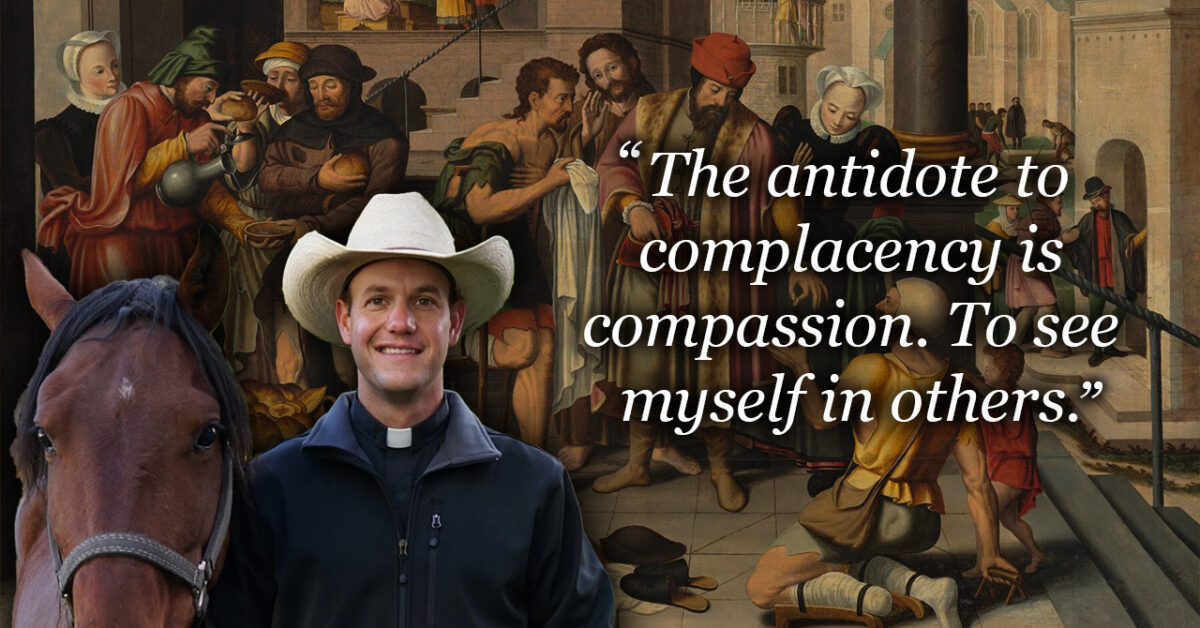
So my deal is, I think the antidote to complacency is compassion. To see myself in others. If I do that, then I’m more apt to be compassionate towards their needs and how I can help alleviate them. St. Paul drives us home too in his letter to Timothy. He says, I charge you before God to keep the commandment without stain or reproach. The commandment, think of what our Lord has asked, what’s the greatest commandment? To love the Lord with all your heart, all your mind, all your soul, all your strength, and then Jesus follows it with the second, to love your neighbor as yourself. That’s compassion, that’s what it is to love my neighbor as myself.
I think, I maybe not just jump into action there, but to first, see myself in my neighbor. If I’m able to see myself in them, put myself in their shoes, then I’m more apt to be compassionate. I’m more apt to be, how can I help out? How can I serve? That’s the deal. We wanna do away with complacency through being compassionate. That’s what we’re after. I wanna be compassionate. How do I do that?
We don’t have Lazarus sitting at our doorstep. Yet there are people in need and I see him and I think, maybe, to help us be aware of them or help, put some flesh on the commandment to be compassionate. Just think of what the Church offers us, the corporal works of mercy and the spiritual works of mercy. It’s interesting. It’s not all just about, my brother who’s physically suffering think about those who are spiritually suffering.
Am I compassionate towards them as well? So I was just gonna run through the corporal and spiritual works of mercy just to kind of remind us, it’d be helpful for us to hear them, go write them down so we have them in front of us. They’re really helpful. They put flesh on this commandment. So corporal works of mercy. Feed the hungry, give drink to the thirsty, clothe the naked, shelter the homeless, visit the imprisoned, care for the sick, and bury the dead.
Those are relatable. I pretty much can see how I could help those, help in those ways, here in our situation. So then the spiritual works of mercy. Instruct the ignorant, counsel the doubtful, admonish the sinner, bear wrongs patiently, forgive willingly, comfort the afflicted, pray for the living and the dead.
These are tangible ways I can put God’s commandment to love my neighbors myself into action. These are relatable. I can understand them. Lazarus might not objectively be at my door, but he’s around me and these are some ways of serving him and not being complacent, but being compassionate. That’s what we’re after and it’s a good way to understand the problem and then then apply the solution of compassion.
If we do this well, then the fruit of it all is contentment. I’m content with what the Lord has given me. I’m not striving out of riches, striving after riches, trying to fill the void in my heart with material things. I’m just content with what the Lord has given me and what he’s given me are to be used for others as well.
Again, St. Paul owned this. In fact, in his letter to the Philippians, he says, not that I complain of want, for I have learned in whatever state I am to be content. I know how to be abased and I know how to abound. In all circumstances, I have learned the secret of facing plenty and hunger, abundance and want. I can do all things in Him who strengthens me. That’s contentment, right? That comes from avoiding the complacency of life with the compassion of our Lord.
To see ourselves in the others. That’s just one little stab here at this, challenging gospel that the Lord gives us. We don’t want to be like, yeah, I’ve heard that before. How do I put it into my action? Here’s the problem, here’s the solution. The corporal works of mercy, the spiritual works of mercy are ways of actually going about this. If we do it well, if we fight complacency with compassion, then we can be content on with whatever the Lord gives us.