Catholic Rural Life members share many commonalities, such as having been raised, or currently working in an agricultural environment. Some do live out the care of creation, and cultivate the land in unique ways. Some come from unlikely places and unexpected fields of work–no pun intended–such as the libraries and classrooms of prestigious universities.
“The first thing I ever wanted to be in life was a farmer,” Fr. Terrence Ehrman, CSC says with fondness.
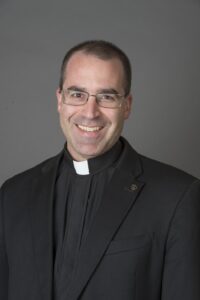
Fr. Ehrman, at first glance, seems to be an unlikely candidate for one who has a passion for agriculture and care for creation. Originally from Baltimore, Maryland, he was not immersed in a rural environment. Though living in the suburbs, from an early age he felt a desire to be close to the land and care for it.
His love and fascination for the natural world grew. He decided to pursue a major in Biology at Notre Dame for his undergraduate degree. This opened the door to many wonderful opportunities for him to deepen his knowledge of creation.
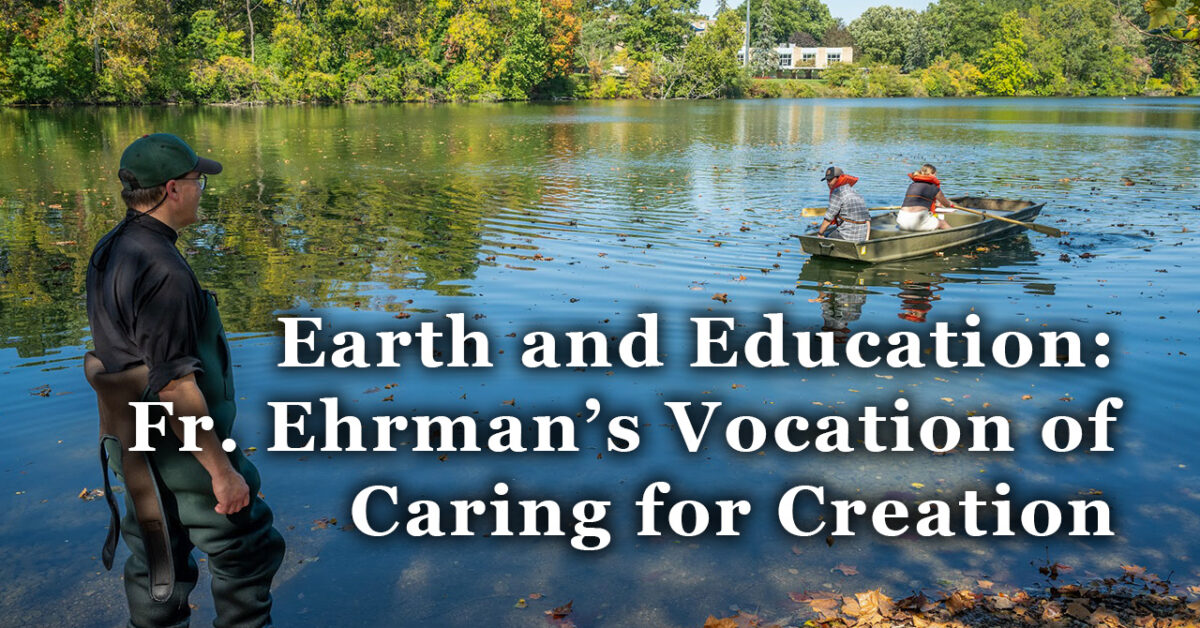
“I spent three glorious summers at Notre Dame’s Biology Field Station in the Upper Peninsula of Michigan and did lake research up there,” he recalls. Fascinated with the study of water, he continued to pursue a Master’s in Stream Ecology in Virginia Tech.
Fr. Ehrman soon answered the call to priesthood in religious life through the Congregation of Holy Cross and was ordained in 2000. His vocation did not put aside his love for the natural sciences, but further deepened it in advanced studies. He began a PhD in Entomology–the study of insects–at the University of Minnesota, and ultimately transitioned to a PhD in Theology from The Catholic University of America in Washington, D.C. Eventually, he returned to the University of Notre Dame and has been teaching undergraduate students on the intersection of theology and creation since 2012.
It was evident that he had a knack for the intellectual life in the Church, and for the tangible reality of the natural world. Over the years, he grew in knowledge of the subject matter, but also began to put that knowledge into practice.
He started doing research on food and agriculture in 2016, learning about the processes in which animals become food for humans. He realized that there were ways in which animals were raised that were not entirely ethical. What he learned began to change his relationship with food, leading to significant lifestyle changes.
Fr. Ehrman experienced a strong drive to be more intentional about food sourcing and consumption. He even went on a primarily pescatarian diet–eating fish instead of mammalian meat–in the process. This proved to be challenging as someone who lived in a community with numerous priests and brothers, and eventually he gave up the endeavor.
Over time, he found creative ways to practice environmental sustainability and care for creation. “In terms of energy, I don’t use the dryer,” he chuckles, “I just hang all my clothes.”
To live a lifestyle that is mindful of the environment is indeed a balancing act, and something that must be integrated reasonably into one’s particular circumstances. Today, Fr. Ehrman lives out these values to the best of his ability as a religious-order priest and professor. One of his primary ways is teaching this awareness to his students. He sees the “eye-opening” realization they experience once they learn about the ways in which meals arrive at their table and connect directly with nature.
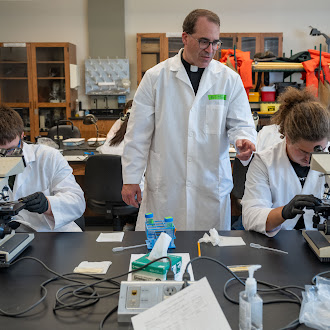
“Farmers are the foundation of a culture,” he says, “because they are the ones that grow our food…I just think if we are going to change our world, we have to have an awareness of where our food comes from.”
It is not simply head knowledge and facts that Father teaches; an instrumental part of his courses is a lab practicum. “If my students are going to learn about creation, they should be out in it,” he states. This lab incorporates what he calls “The Tree Project”, lasting approximately 11 weeks. The students choose a tree on campus grounds and quietly observe it for 10-15 minutes on a regular basis.
Fr. Ehrman observes that such a simple practice has a profound, positive impact on his pupils. The time away from noise and screens is a welcome experience for them.
“I’m ultimately trying to get them to be attentive to God’s world, and who God is as its Creator,” he explains. “How do we have a sacramental vision of reality? There’s a red maple tree that’s blossoming, blooming…do we encounter Jesus Christ in and through this red maple tree?”
He recognizes that everything points to God, and the immense spiritual significance in the fruits of the earth we grow, especially as the Church uses natural elements–bread, wine, water–for many of the sacraments.
“Fundamentally, our life begins in a garden,” he reflects, referring to the creation story in Genesis. “As we become more urban and suburban, and technological, there is a natural gravitation to our world.”
Though having been in higher academia for over a decade, Fr. Ehrman continues to live out his desire to be close to nature and care for it. His story and vocation prove that the call to stewardship of the land is fulfilled in a variety of ways: as farmer, homesteader, and even as priest and professor.